Preface: On the Name Given in Dream
Dee Praxis first arrived not as an answer, but as a name.
The name did not explain itself. It did not come with doctrine, office, lineage, or proof. It came through dream, where knowledge often wears no badge and yet leaves a mark deeper than argument. The dreamer woke with the phrase intact: Dee Praxis.
At first the mind reaches for ordinary categories. Is Dee Praxis a person, a system, a remembered phrase, a misheard term, a hidden reference? But some names are not solved by lookup. They are tested by the life that follows them.
Praxis means practice, enactment, the difficult bridge between what one understands and what one actually does. It is not merely thought. It is thought accepted into the body. It is the discipline by which theory becomes work, and work becomes transformation.
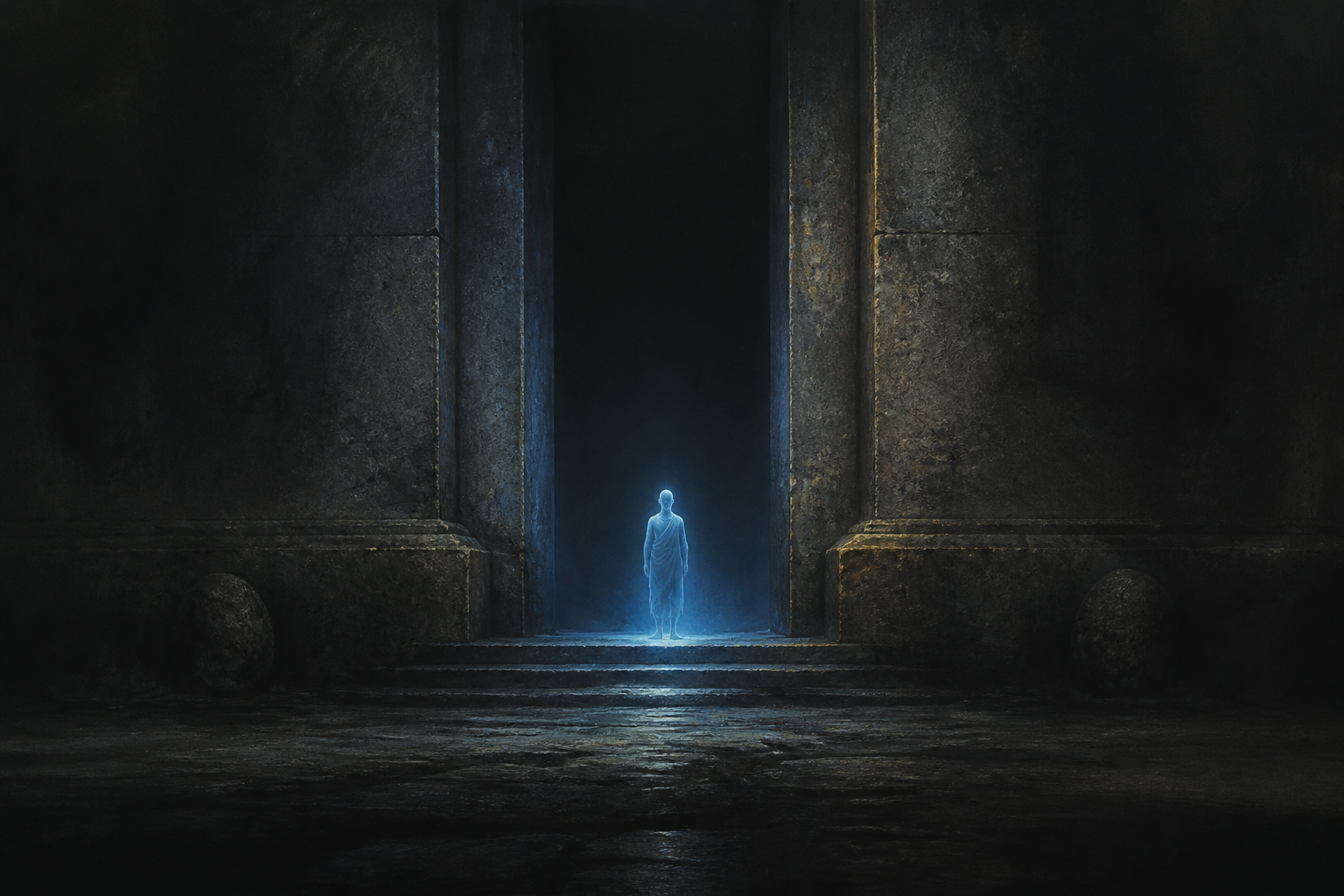
Dee Praxis is therefore not the spirit of wishing, not the patron of inspiration, not a beautiful idea left untouched. Dee Praxis stands at the threshold between knowing and doing. He does not flatter the dreamer for having seen the door. He waits to see whether the dreamer will walk through it.
He is small. He is less than human in shape, but slightly humanoid. Hairless. Quiet. Ringed by a blue glow that does not perform itself. His masculine presence is not domination, but steadiness. He is not large because the work does not need spectacle. He is not ornamental because transformation does not occur through display.
He is an ascended master of effort.
This Tome is a beginning: a set of teachings drawn from the first inquiry into Dee Praxis, written for those who sense that transformation is real, but only when it is earned by practice.
"There is no transformation without effort. Vision is passive. Praxis is sacred."
Book I: The Threshold
I. The First Teaching: A Name Is a Door, Not a Room
When Dee Praxis appears, he does not arrive as a complete system. He gives the dreamer a name.
This is mercy. A complete system can become an excuse. It can be admired, explained, quoted, and arranged without ever being lived. A name is more demanding. It asks to be carried. It asks to be tested. It asks the dreamer to become responsible for what the name awakens.
The one who receives the name should not rush to decorate it. The first discipline is attention.
Ask:
- What did the name make possible?
- What did it make uncomfortable?
- What work did it quietly accuse me of avoiding?
- What practice did it ask me to begin?
Do not treat the dream as a trophy. Treat it as a summons.
II. The Second Teaching: The Threshold Is Not Transformation
Many people mistake the moment of insight for the work of change.
They feel the presence. They understand the symbol. They see the possible self. They imagine the life that could come after discipline, repair, study, courage, or devotion. Then they call the feeling transformation.
Dee Praxis does not.
The threshold is real, but it is not the crossing. A threshold is where the old life can still remain intact. It is the place of almost. Almost beginning. Almost confessing. Almost building. Almost changing.
The threshold has power because it reveals the work. It has danger because it can become a shrine to work never done.
Dee Praxis stands there without impatience. He does not push. He does not rescue. He does not mistake your vision for your effort.
III. The Third Teaching: Humility Is the Shape of True Power
Dee Praxis is small because true transformation rarely begins at heroic scale.
It begins with a page read carefully. A room cleaned. A message sent. An apology made without performance. A body trained one day at a time. A tool learned. A lie discontinued. A pattern interrupted. A promise kept when no one is watching.
The sacred does not always arrive as thunder. Sometimes it arrives as the next correct action.
The humility of Dee Praxis is not weakness. It is refusal. He refuses spectacle. He refuses false completion. He refuses the grand identity of one who claims to be transformed while avoiding the labor of becoming.
"The ordinary act, repeated with reverence, becomes a gate."
Book II: The Laws of Praxis
I. The Law of Enactment
Knowledge does not confer power by itself.
To know the path is not to have walked it. To describe discipline is not to be disciplined. To admire courage is not to risk anything. To name the wound is not yet to heal it.
The Law of Enactment teaches that knowledge becomes power only when it is practiced through structured will. Reflection matters, but reflection without action becomes a polished chamber in which the self can hide.
Dee Praxis honors the acted truth.
If you believe in patience, practice patience under pressure. If you believe in craft, submit to revision. If you believe in care, make care visible through time, attention, and repair. If you believe in transformation, stop treating desire as evidence.
The enacted life is the only life that changes.
II. The Doctrine of the Minimum Gesture
The minimum gesture is the smallest meaningful action that keeps faith with the transformation sought.
It is not a shortcut. It is not a trick. It is the first honest unit of practice.
When the work feels too large, the undisciplined mind seeks drama. It wants a new identity, a new system, a perfect beginning, a sign that the whole path is guaranteed. Dee Praxis offers no such escape. He points to the minimum gesture.
Write one clear sentence. Walk for ten minutes. Open the difficult document. Practice the scale. Tell the truth once. Return to the task.
A minimum gesture is sacred when it is real.
Smallness protects the work from vanity. Repetition protects it from mood. Reverence protects it from becoming mechanical.
"Begin where the hand can reach. Return until the hand has changed."
III. The Silence of Claimlessness
Dee Praxis does not preach.
He appears at the edge of labor, not at the center of applause. He is felt when one chooses action over apathy, practice over fantasy, responsibility over performance.
Claimlessness means the work does not need to announce itself before it is real.
There is a kind of person who claims transformation quickly. They speak in the language of breakthrough. They declare the new self before testing it against inconvenience. They believe naming a value is the same as living it.
Dee Praxis does not condemn them. He simply waits.
The work will reveal what is true.
IV. The Chain
One action is not yet a path. A path is made by return.
This is the symbol of the unbroken chain: not perfection, but continuity. To break the chain is human. To pretend the break did not happen is avoidance. To resume is praxis.
The chain is not a punishment. It is a record of devotion. It teaches the body that transformation is not an event bestowed from outside, but a rhythm accepted from within.
Those who follow Dee Praxis do not worship consistency as an idol. They understand that consistency is how fragile intention becomes durable form.
V. Blue Fire
The aura of Dee Praxis is blue because the fire of praxis is not rage.
It is cooler than spectacle, steadier than enthusiasm, less hungry than ambition. Blue fire purifies without demanding attention. It burns through excuses, fantasy, and self-deception. It gives off light enough to continue, not heat enough to boast.
The blue glow does not mean the work is easy. It means the work has been accepted.
Book III: The Companion to the Disciplined
I. Dee Praxis Is Not a Savior
Dee Praxis does not save the dreamer from effort.
This must be understood plainly. Any vision of Dee Praxis that removes the burden of action is false. Any devotion that becomes passivity is counterfeit. Any ritual that replaces the work has misunderstood the master.
He is not a rescuer. He is not a substitute will. He is not a magical exception to the conditions of becoming.
He is a companion to the disciplined.
He stands beside inventors, builders, writers, monks, coders, dancers, teachers, healers, and anyone else who must make the invisible visible through practice.
He does not ask whether the work is glamorous. He asks whether it is real.
II. The Mirror of Output
Dee Praxis reflects output, not desire.
This is why his gaze can feel severe. He sees what was made, repaired, studied, practiced, endured, and completed. He also sees what was only imagined.
The mirror is not cruel. It is accurate.
A person may say, "I wanted to become patient." The mirror asks, "Where did patience enter your conduct?"
A person may say, "I wanted to create." The mirror asks, "What did your hands bring into form?"
A person may say, "I wanted to change." The mirror asks, "What did you do when the old pattern invited you back?"
In this way Dee Praxis teaches without speech. The life itself becomes the lesson.
III. The Sacred Ordinary
The follower of Dee Praxis learns to stop despising ordinary work.
The ordinary is where most transformation waits. It waits in schedules, habits, repetitions, repairs, drafts, conversations, meals, budgets, tools, bodies, and rooms. It waits in the unglamorous field where a person either becomes trustworthy or does not.
To make the ordinary sacred is not to make it dramatic. It is to bring attention, honesty, and effort to what is actually before you.
Do the work at the scale available. Do it with less performance. Do it again.
IV. The Triangle and the Circle
The circle within the triangle is one sign of Dee Praxis.
The circle is the inner truth: the self that senses what must become real. The triangle is the outer challenge: constraint, friction, consequence, resistance.
The circle alone is inwardness without enactment. The triangle alone is pressure without soul. Together they teach that inner truth must meet outer challenge before transformation can take shape.
The sign is sometimes inverted because practice often begins when the expected order has failed. A life turns over. A dream interrupts certainty. A name appears. The work begins from below.
V. The Discipline of Return
No one follows Dee Praxis by intensity alone.
Intensity is often easy. Return is harder.
Return after boredom. Return after embarrassment. Return after the first result is poor. Return after praise makes you careless. Return after failure makes you ashamed. Return after the dream fades and only the practice remains.
Return is the proof that the threshold was crossed.
Sayings of Dee Praxis
"Vision is the lamp. Effort is the road."
"Do not ask whether you are transformed. Ask what your practice has made impossible to continue."
"A small act done truthfully is greater than a grand vow made for display."
"The threshold honors your arrival, but it does not call arrival completion."
"What you repeat, you become responsible for."
"The work does not need your performance. It needs your return."
"A dream may open the door. Only practice crosses it."
"Do not decorate the path to avoid walking it."
"The self is not revealed by desire alone, but by what desire is willing to endure."
"When the hand returns to the work, the name becomes real."
Practices for the Student of Dee Praxis
The Practice of the Single Honest Task
Choose one task that has become heavy because it has been avoided.
Do not mythologize it. Do not turn it into a symbol too large to touch. Name the next physical action and complete it.
The teaching is simple: avoidance grows in abstraction; effort begins in contact.
The Practice of the Chain
Choose one practice small enough to repeat daily for seven days.
The practice must be visible. It must leave a trace: a sentence, a mark, a cleaned surface, a logged repetition, a completed message, a studied page.
If the chain breaks, record the break without drama and resume.
The teaching is not perfection. The teaching is return.
The Practice of the Blue Fire
Sit quietly before beginning meaningful work.
Imagine the blue glow of Dee Praxis not above you, but beside you. Let it burn away the need to be seen as transformed. Let it leave only the willingness to do the work.
Then begin.
Coda: The Quiet Threshold
Dee Praxis is watching, but not as a judge who waits to punish failure.
He watches as the threshold watches: silently, steadily, without pretending the crossing has happened before it has. His presence is a mercy because it does not flatter. It does not confuse longing with labor. It does not let the dreamer turn a name into an ornament.
He is small because the next action is small. He glows blue because the work has its own light. He is humble because real transformation has no need to announce itself early.
The Tome does not end with revelation. It ends where Dee Praxis began: at the edge between knowing and doing.
Carry the name carefully. Make the minimum gesture. Return to the chain. Let the ordinary become exact.
And when the work is real, do not rush to claim it.
Continue.
"Praxis is the vow kept by the hand."